
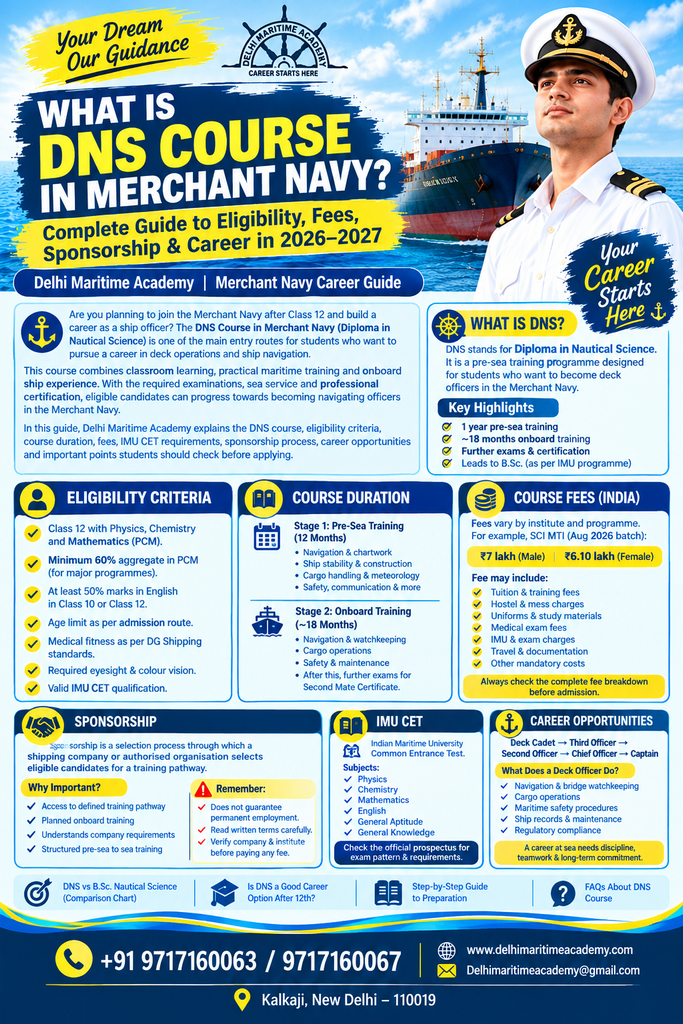
What Is DNS Course in Merchant Navy Complete Guide to Eligibility, Fees, Sponsorship & Career in 2026–2027
Delhi Maritime Academy | Merchant Navy Career Guide
Are you planning to join the Merchant Navy after Class 12 and build a career as a ship officer? The DNS Course in Merchant Navy (Diploma in Nautical Science) is one of the main entry routes for students who want to pursue a career in deck operations and ship navigation.
This course combines classroom learning, practical maritime training and onboard ship experience. With the required examinations, sea service and professional certification, eligible candidates can progress towards becoming navigating officers in the Merchant Navy.
In this guide, Delhi Maritime Academy explains the DNS course, eligibility criteria, course duration, fees, IMU CET requirements, sponsorship process, career opportunities and important points students should check before applying.
- What Is DNS Course in Merchant Navy
DNS stands for Diploma in Nautical Science. It is a pre-sea training programme designed for students who want to become deck officers in the Merchant Navy.
The programme prepares students to understand ship navigation, cargo operations, maritime safety, ship maintenance and other responsibilities related to deck operations.
The DNS pathway generally includes:
One year of pre-sea training at a maritime training institute.
Approximately 18 months of structured onboard training, depending on the approved programme.
Further required training and examinations for the Second Mate Certificate of Competency.
Progression towards working as a qualified navigating officer after meeting all applicable requirements.
The DNS programme can lead to a B.Sc. qualification through the applicable Indian Maritime University programme, subject to completing the prescribed academic and training requirements. - DNS Course Eligibility Criteria 2026–2027
Before applying for a DNS course, students must verify their academic qualifications, age, English marks and medical fitness.
General eligibility requirements
Educational qualification: Class 12 or equivalent with Physics, Chemistry and Mathematics (PCM).
PCM percentage: Many DNS admission routes require at least 60% aggregate in PCM.
English marks: Commonly, at least 50% in English in Class 10 or Class 12.
Age limit: The applicable age limit depends on the admission route and institute.
Medical fitness: Candidates must satisfy the applicable Directorate General of Shipping medical standards.
Eyesight and colour vision: Candidates must meet the prescribed nautical-course vision standards.
Entrance examination: A valid IMU CET qualification is required for the applicable DNS admission route.
Some institutes and shipping companies have stricter academic, age or selection requirements. Always check the current official prospectus and the specific institute’s eligibility criteria before applying. - DNS Course Duration
The DNS course pathway generally involves two main stages.
Stage 1: Pre-Sea Training — 12 Months
Students complete residential training at an approved maritime training institute. The curriculum combines theoretical subjects with practical training.
Subjects may include:
Navigation and chartwork
Ship stability and construction
Cargo handling
Meteorology
Maritime safety
Shipboard communication
Maritime regulations
Practical and simulator training
Stage 2: Onboard Ship Training — Approximately 18 Months
After successfully completing the pre-sea programme and meeting the relevant requirements, cadets proceed to structured shipboard training.
During this period, they learn under experienced ship officers and gain practical experience in navigation, watchkeeping, safety procedures, cargo operations and daily shipboard responsibilities.
After completing the required sea service, training and examinations, candidates can progress towards the relevant Certificate of Competency.
Important: Completing the classroom course alone does not make a student a qualified deck officer. The required onboard training and professional examinations must also be completed. - DNS Course Fees in India
The total DNS course fee varies according to the institute, accommodation, training facilities, additional charges and the specific admission programme.
For example, the Shipping Corporation of India’s Maritime Training Institute published a DNS course fee of ₹7 lakh for male candidates and ₹6.10 lakh for female candidates for its August 2026 batch, subject to its stated terms and revisions.
These figures are an institute-specific example, not a fixed fee for every DNS college.
Before taking admission, ask for a written fee breakdown covering:
Tuition and training fees
Hostel and mess charges
Uniforms and study materials
Medical examination fees
IMU and examination charges
Travel and documentation expenses
Any additional mandatory training costs
Compare the complete cost of the programme rather than relying only on the advertised tuition fee. - What Is DNS Sponsorship in Merchant Navy
DNS sponsorship is a selection process through which a shipping company or an authorised organisation selects eligible candidates for a particular training pathway.
Depending on the programme, sponsorship may be connected to admission, planned onboard training or both. The precise arrangement depends on the company and institute.
Why Is Sponsorship Important
It can help candidates access a defined training pathway.
It may provide a planned opportunity for onboard training.
It allows candidates to understand the company’s selection and training requirements.
It can make the transition from pre-sea training to sea training more structured.
However, sponsorship does not automatically guarantee permanent employment or a lifelong job. Read the written sponsorship terms carefully, including the conditions for onboard training, employment and any applicable fees.
Before paying money, verify the shipping company, authorised recruitment channel and institute through official sources. Be cautious of anyone promising guaranteed jobs or demanding unofficial payments. - What Is IMU CET and Why Is It Important for DNS
IMU CET stands for Indian Maritime University Common Entrance Test.
It is an important entrance examination for admission to applicable maritime programmes, including DNS.
Students preparing for IMU CET should focus on the subjects and examination requirements specified in the current admission prospectus.
Preparation commonly involves:
Physics
Chemistry
Mathematics
English
General aptitude
General knowledge
The precise examination pattern and admission procedure should be checked in the official IMU prospectus for the relevant academic year.
Candidates should also check whether their chosen shipping company or maritime institute conducts additional tests, interviews or medical assessments. - Career Opportunities After DNS Course
The DNS pathway is designed for students interested in the deck department of merchant ships.
After completing the necessary training, sea service and examinations, candidates may progress through the following career pathway:
Deck Cadet → Third Officer → Second Officer → Chief Officer → Captain
Each promotion depends on meeting the relevant sea-service requirements, passing professional examinations, obtaining the required certificates and satisfying company requirements.
What Does a Deck Officer Do
Deck officers are responsible for important aspects of ship navigation and operations, including:
Assisting with safe navigation and bridge watchkeeping
Supporting cargo loading and unloading operations
Following maritime safety procedures
Maintaining shipboard records
Helping supervise deck maintenance
Supporting compliance with applicable maritime regulations
A career at sea requires discipline, teamwork, professional competence and the ability to work away from home for extended periods. - DNS vs B.Sc. Nautical Science: What Is the Difference
Both pathways are designed for students interested in becoming deck officers, but their programme structures differ.
Feature DNS B.Sc. Nautical Science
Main focus Pre-sea nautical training Degree-based nautical education
Typical initial training 1 year 3 years
Onboard training Commonly around 18 months Depends on the applicable programme
Entrance requirements IMU CET for applicable admissions IMU CET for applicable admissions
Career direction Deck officer pathway Deck officer pathway
The exact academic structure, sea-training requirements, degree award and eligibility conditions depend on the approved programme. Review the current institute prospectus before deciding which route suits you. - Is DNS a Good Career Option After 12th
DNS may be a suitable option for students who enjoy navigation, mathematics, practical learning and working in an international maritime environment.
Before choosing the course, consider both its opportunities and its demands.
Potential advantages
A structured route towards a deck officer career
Opportunities to gain international maritime experience
A professional career progression pathway
Exposure to ship navigation and cargo operations
Important considerations
Strict academic and medical eligibility requirements
Competitive company selection and sponsorship processes
Time spent away from family while sailing
Professional examinations and continuing training
Employment opportunities that depend on qualifications, performance and company requirements
Research the profession carefully and make an informed decision rather than choosing a course solely because of advertised salary figures. - How to Start Your DNS Course Preparation
Students interested in DNS can begin with these steps: - Check your Class 12 PCM marks and English marks against the current eligibility criteria.
Review the official IMU CET admission notification.
Identify suitable IMU-affiliated and appropriately approved maritime training institutes.
Understand the sponsorship and selection requirements of your chosen programme.
Prepare for the entrance examination and any company selection tests.
Complete the required medical examination through an appropriately approved doctor.
Verify the fee structure, training arrangements and written terms before making a payment.
Early preparation can help students understand the admission process and avoid missing important requirements.
Frequently Asked Questions About DNS Course
Q1. What is the full form of DNS in Merchant Navy
DNS stands for Diploma in Nautical Science. It is a pre-sea training programme for students pursuing a career as deck officers.
Q2. Can I join DNS after Class 12
Yes. Eligible students who have completed Class 12 with Physics, Chemistry and Mathematics can apply, provided they satisfy the current academic, entrance examination, age and medical requirements.
Q3. Is IMU CET compulsory for DNS
IMU CET is required for the applicable IMU DNS admission route. Candidates should check the current official prospectus and the admission requirements of their chosen institute.
Q4. Is sponsorship necessary for DNS
Sponsorship requirements depend on the programme and admission route. Some DNS pathways require company sponsorship as part of selection or training arrangements. Always verify the specific programme’s requirements before applying.
Q5. How long does the DNS course take
The typical pathway includes 12 months of pre-sea training and approximately 18 months of onboard training, followed by any additional required training and examinations.
Q6. How much does a DNS course cost
Fees vary by institute and programme. Check the latest official fee structure and include hostel, examination, medical and other applicable expenses when calculating the total cost.
Q7. Can DNS students become captains
Yes, the DNS pathway can lead towards a Captain or Master Mariner career. However, candidates must gain the required sea experience, complete further training, pass the relevant examinations and obtain the necessary professional certificates.
Q8. Is DNS suitable for students who want to become ship officers
DNS is intended for students pursuing the deck officer pathway. Students should assess their academic interests, medical eligibility and willingness to work at sea before choosing the course.
Conclusion
The DNS Course in Merchant Navy is an important pathway for eligible Class 12 PCM students who want to pursue a career in ship navigation and deck operations.
Understanding eligibility criteria, IMU CET, sponsorship, course fees, onboard training and professional examinations can help students make better decisions about their maritime education.
At Delhi Maritime Academy, students can seek guidance on Merchant Navy career options, IMU CET preparation, sponsorship processes and the steps involved in planning their maritime career.
Planning to pursue DNS after Class 12? Contact Delhi Maritime Academy for course guidance and IMU CET preparation information.
Delhi Maritime Academy
Address: 105, More Pocket 1, Kalkaji, New Delhi – 110019
Contact: 9717160063 / 9717160067